
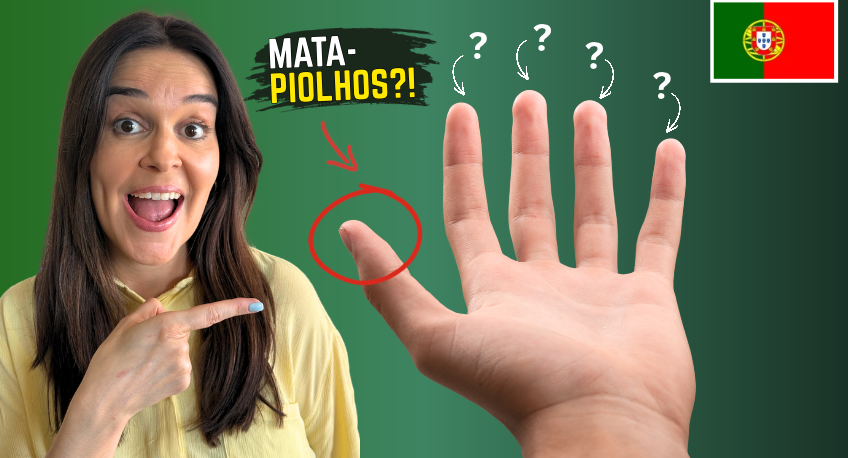
Have you ever thought about the way you count with your fingers?
It seems like something that should be pretty universal. You want two coffees, so you hold up two fingers. Simple, right?
Well, not necessarily.
The way we count with our fingers can actually be surprisingly cultural. People in different countries may start with different fingers or use different gestures to represent the same number.
And in Portugal, there is something else that makes our fingers particularly interesting: their names.
Of course, we have the standard Portuguese words for thumb, index finger, middle finger and so on. But we also have a second set of traditional names that many Portuguese people learn as children.
And some of them are quite funny.
Have you ever heard of a fura-bolos (“cake poker”)? Or, even better, a mata-piolhos (lice killer)?
In this article, you’ll learn the names of all five fingers in European Portuguese, including their traditional names. We’ll also look at how Portuguese people normally count with their fingers.
Prefer to Watch the Video?
I also made a YouTube video about this topic, where you can hear the Portuguese words pronounced and see exactly how we count with our fingers in Portugal.
I regularly post new videos about European Portuguese vocabulary, pronunciation, grammar and Portuguese culture on my YouTube channel. If you enjoy learning Portuguese with me, you can also subscribe to my channel so you don’t miss the next one.
Now, let’s look at those finger names!
The Official Names of the Fingers in European Portuguese
Let’s start with the standard names you are most likely to encounter when learning European Portuguese.
| English | European Portuguese |
|---|---|
| Little finger / pinky | dedo mínimo |
| Ring finger | dedo anelar |
| Middle finger | dedo médio / dedo do meio |
| Index finger | dedo indicador |
| Thumb | polegar |
Some of these Portuguese words are actually quite easy to remember once you understand where they come from.

Dedo mínimo: the little finger
The smallest finger is dedo mínimo.
The word mínimo refers to something very small or minimal, so the connection is quite straightforward.
However, there is another word for this finger that you’ll hear very often in Portugal: mindinho.
We’ll come back to that one in a moment.
Dedo anelar: the ring finger
Next, we have dedo anelar.
This is the finger where we normally wear an anel, meaning “ring” in Portuguese. That makes anelar relatively easy to remember.
Dedo médio or dedo do meio: the middle finger
The middle finger is commonly called dedo médio or simply dedo do meio.
Do meio literally means “of the middle”, so this one is pretty straightforward.
Dedo indicador: the index finger
The index finger is dedo indicador.
This name is connected to the Portuguese verb indicar, meaning “to indicate”, because this is usually the finger we use to point at something.
Polegar: the thumb
Finally, we have polegar, which is the thumb.
For many students learning European Portuguese, polegar can be a little harder to remember because the word doesn’t immediately resemble other familiar words.
Luckily, the traditional name for the thumb is much harder to forget. We’ll get to that one in a moment!
The Funny Traditional Names for Fingers in Portuguese
Now we get to the fun part.
In Portugal, there are also traditional and playful names for the five fingers. Many Portuguese children grow up hearing these names through games, rhymes and other childhood traditions.
Starting with the little finger and working towards the thumb, we have:
Mindinho → Seu vizinho → Pai de todos → Fura-bolos → Mata-piolhos
Yes, those last two really are names for fingers in Portuguese!
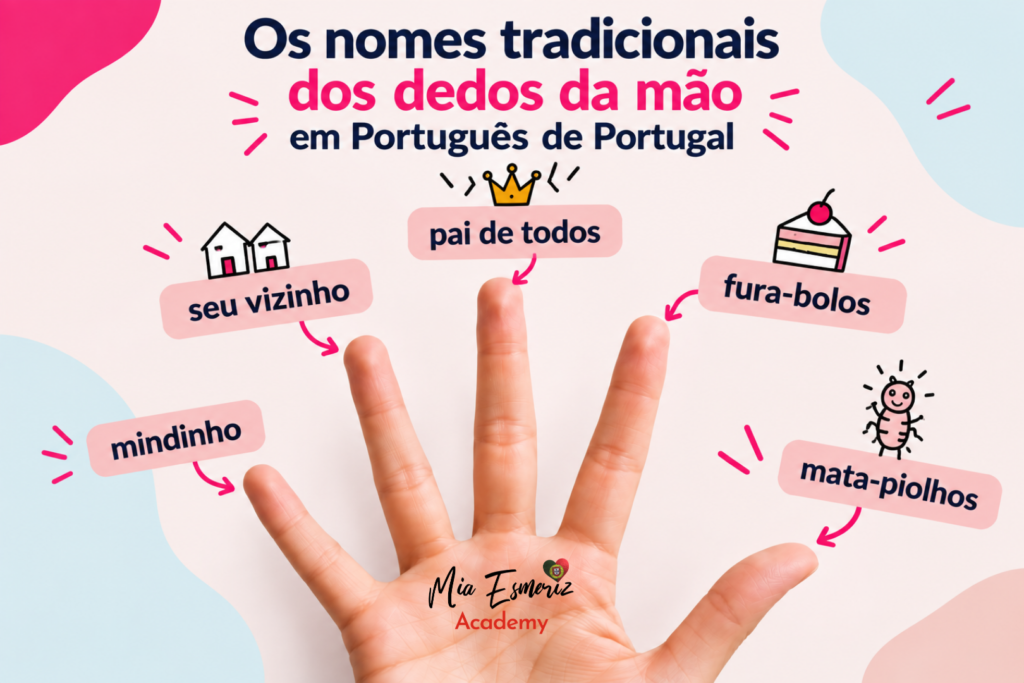
Let’s look at them one by one.
Mindinho
The little finger can be called mindinho.
Unlike some of the other names on this list, mindinho isn’t just a funny childhood expression. It is extremely common in everyday European Portuguese.
In fact, you may hear mindinho more often than the official dedo mínimo.
So, if you’re learning Portuguese, this is definitely a useful word to remember.
Seu vizinho: “its neighbour”
The ring finger can traditionally be called seu vizinho, which means “its neighbour.”
Whose neighbour?
The mindinho’s, of course!
It sits right next to the little finger. There is also another good reason for the name: mindinho and vizinho rhyme.
Pretty cute, right?
Pai de todos: “father of them all”
Next comes the middle finger, which can be called pai de todos.
Literally:
pai = father
de todos = of them all
So the middle finger becomes the “father of them all.”
One possible explanation is that the middle finger is usually the tallest finger and stands above the others.
Very patriarchal of us!
Fura-bolos: “cake poker”
This might be my favourite.
The index finger can traditionally be called fura-bolos.
Let’s break that word down:
furar = to pierce / to poke
bolos = cakes
So a fura-bolos is literally a “cake poker.”
The idea is that this would be the finger children used to poke a cake or sneak a little bit of cake or something sweet.
Imagine starting to learn Portuguese and discovering that the perfectly ordinary dedo indicador you learned in your textbook can also be called fura-bolos!
That’s certainly one way to make Portuguese vocabulary more memorable.
Mata-piolhos: “lice killer”
And finally, we arrive at perhaps the strangest Portuguese finger name of them all:
mata-piolhos.
This is another compound word:
matar = to kill
piolhos = lice
So mata-piolhos literally means “lice killer.”
And which finger receives this glamorous title?
The thumb!
The idea is that the thumb was used to crush lice.
Very elegant. Very glamorous. Very Portuguese. 🤣
If you ever struggle to remember the Portuguese word polegar, perhaps knowing that your thumb can also be called mata-piolhos will help!
Portuguese Finger Names: A Quick Overview
Here are the standard and traditional names together:
| Finger | Standard Portuguese | Traditional name |
|---|---|---|
| Little finger | dedo mínimo | mindinho |
| Ring finger | dedo anelar | seu vizinho |
| Middle finger | dedo médio / dedo do meio | pai de todos |
| Index finger | dedo indicador | fura-bolos |
| Thumb | polegar | mata-piolhos |
If you’re learning European Portuguese for everyday communication, I would definitely remember mindinho in addition to the standard finger names.
The other traditional names are particularly interesting from a cultural perspective. Although, I suspect fura-bolos and mata-piolhos might now be considerably harder for you to forget than indicador and polegar!
How Do Portuguese People Count With Their Fingers?
Finger names aren’t the only thing that can vary between countries.
The way we count with our fingers can be cultural too.
In Portugal, we normally start counting with the index finger, rather than the thumb.
On one hand, we generally count like this:
1: index finger
2: index + middle finger
3: index + middle + ring finger
4: all four fingers except the thumb
5: the whole hand
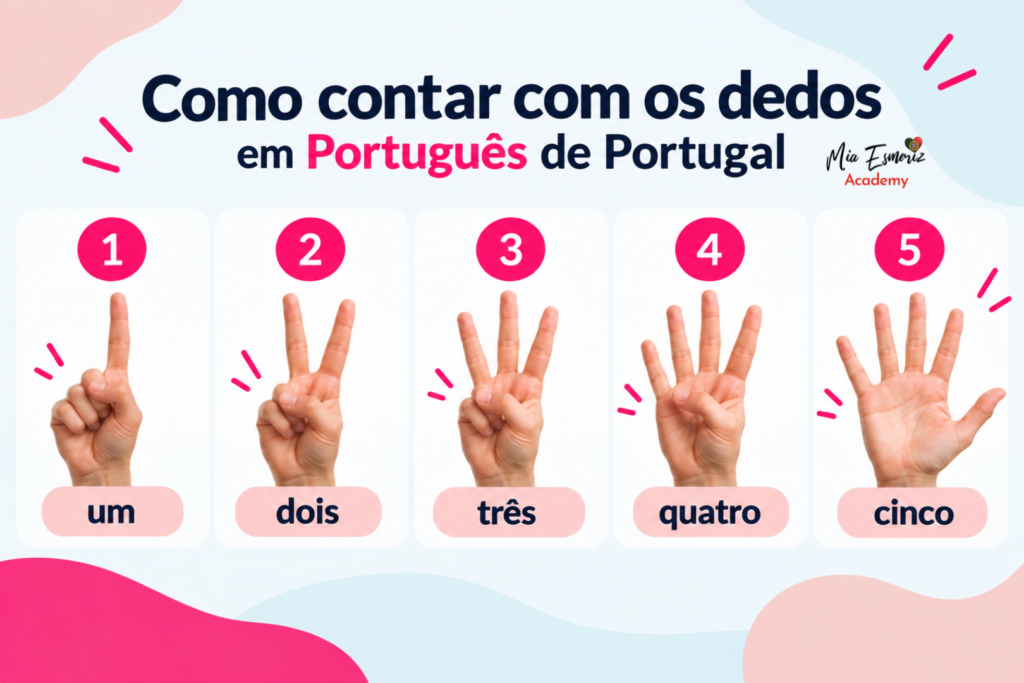
For six, we normally begin using the other hand and continue until both hands are open for ten.
This might seem completely natural to you.
Or perhaps it looks completely wrong!
That depends a lot on where you grew up. Some cultures start counting with the thumb, while others use different combinations and gestures.
There is even a famous scene in Quentin Tarantino’s Inglourious Basterds that revolves around this cultural difference. A character pretending to be German gives himself away after using the “wrong” fingers to indicate a number.

It might sound like an incredibly small detail, but gestures like these can reveal more about us than we realise.
These small differences are part of what makes Portuguese culture so interesting. If you enjoy discovering these little cultural details, you might also like my article about 8 strange cultural habits that are SO Portuguese.
Using Finger Gestures in Portugal
Now imagine you’re sitting in a busy Portuguese café.
It’s noisy, the waiter is a few metres away and you want dois cafés.
Instead of trying to shout over everyone, you might simply say dois cafés and hold up two fingers.
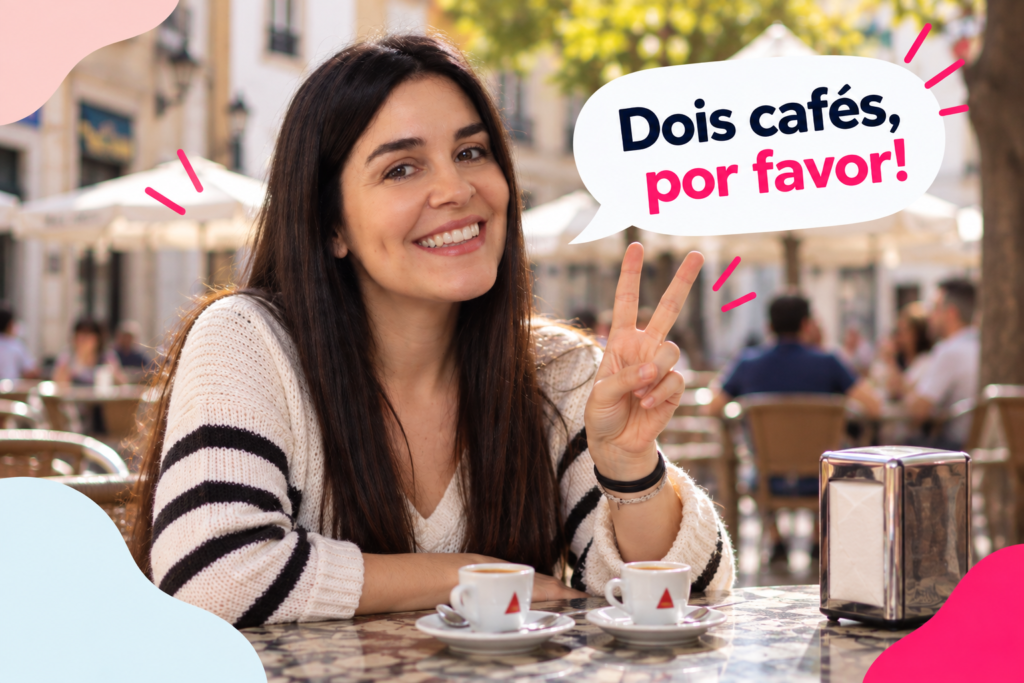
The same thing can happen when ordering três cervejas (three beers), for example.
These tiny gestures are part of everyday communication.
Of course, nobody is going to think you’ve committed a terrible cultural mistake because you started counting with your thumb! But noticing these little differences helps you understand how people actually communicate in Portugal.
And that is an important part of learning European Portuguese.
Learning Portuguese Is About More Than Vocabulary
When you learn a language, you don’t just learn vocabulary and grammar.
You also discover gestures, habits, childhood traditions, cultural references and all those little things native speakers do without even thinking about them.
Music is another great example of this. In my article about learning European Portuguese with Fado, I show you how Portuguese music can help you learn vocabulary, pronunciation and culture at the same time.
Those cultural details often end up being some of the most memorable parts of learning a language.
Anyone can memorise a vocabulary list.
But discovering that Portuguese people can call their thumb mata-piolhos?
That one might stay with you forever!
How Do You Count With Your Fingers And Name Them?
Now I’m curious: how do you count with your fingers in your country?
Do you start with your index finger like we commonly do in Portugal, or do you start with your thumb?
And do you have any funny or unusual names for the fingers in your language?
Let me know in the comments below! I’d love to compare the different ways people name and count with their fingers around the world.
And if you’re just starting to learn European Portuguese and would like to build a strong foundation, check out my free Kickstart Your Portuguese – The Basics course.
It’s a simple and structured introduction to European Portuguese that will help you start speaking and understanding Portuguese with more confidence.
Beijinhos,
Mia