
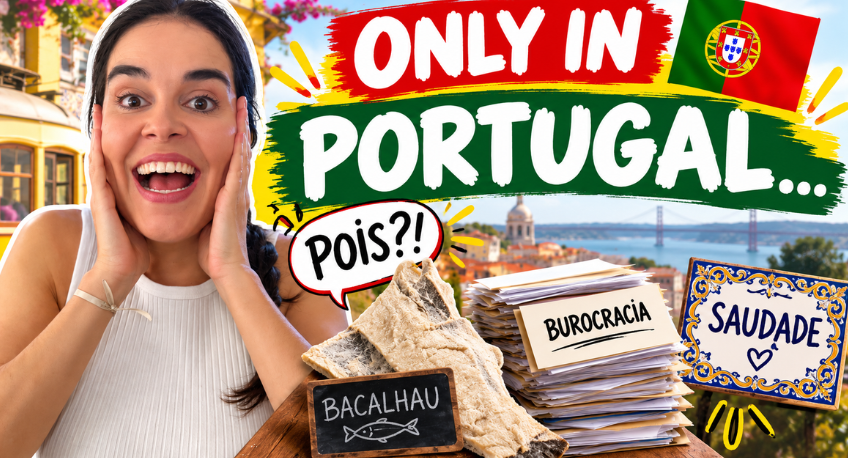
If you’ve ever visited or lived in Portugal, you’ve probably experienced a moment when you stopped and thought:
“Wait… what is happening here?”
Every country has its own little cultural habits, and Portugal is certainly no exception.
From using one tiny word to express almost anything to spending hours around the lunch table, there are certain Portuguese cultural habits that can be surprising, funny or even slightly confusing when you first encounter them.
So, whether you’re learning European Portuguese, planning a trip to Portugal or already living here, here are 8 strange cultural habits that are SO Portuguese.
1. “Pois” Can Mean Almost Anything
If you spend enough time around Portuguese people, there’s one word you’re going to hear a lot:
Pois.
It might be one of the most versatile words in European Portuguese.
Depending on the situation and, importantly, the way you say it, pois can express things such as:
- “Yes, I agree.”
- “I understand.”
- “I disagree, but I’m not going to argue.”
- “I don’t believe you.”
- “Of course!”
- “Really?”
And that’s still not everything!
For example, imagine someone says:
“Está a chover muito hoje!”
It’s raining a lot today!
You could simply nod and answer:
“Pois!”
Or:
“Pois está!”
And if someone is telling you a very long and dramatic story?
An occasional “Pois, pois…” can be a very useful way to show that you’re listening.
Once you start noticing pois in real Portuguese conversations, you’ll hear it everywhere. If you want to learn more about “pois” in Portuguese, you can check this post here.
2. We Stop to See What’s Happening
Something happens on the side of the road.
An accident. A disagreement. A fire. Maybe even just a broken traffic light.
What happens next?
People look.
Portuguese people seem to have a special curiosity whenever something unusual is happening nearby.
You can even see this on the road. An accident might have happened on the opposite side, yet traffic starts slowing down in your direction too because everyone wants to see what happened.
And sometimes looking isn’t enough.
People might approach those involved, ask questions and even offer their own opinions.
Something along the lines of:
“Ai, que chatice! Mas foi culpa de quem?”
Oh, what a nuisance! But whose fault was it?
A little curiosity can go a long way in Portugal!
3. Saying “No” Without Actually Saying “No”
Portuguese people can sometimes be rather indirect when saying no, especially in certain social situations.
Instead of giving you a straightforward não, you might hear:
“Vamos ver…”
We’ll see…
Be careful. There’s a good chance that means no.
Or:
“Talvez mais tarde…”
Maybe later…
Again, quite possibly no.
And then there’s the classic:
“Ah, depois combinamos…”
Ah, we’ll arrange something later…
You might not want to clear your calendar just yet.
Of course, these expressions don’t literally mean no every single time. But context is everything, and learning to recognize these little clues is an important part of understanding everyday Portuguese communication.
4. Portuguese Bureaucracy Will Test Your Patience
Ah, bureaucracy.
If you love filling in forms, waiting in queues and being sent from one department to another, Portugal might have something special in store for you.
Sometimes, getting what seems like a simple document can turn into quite an adventure.
You might:
- Fill in a form to make your request.
- Get sent to three different departments before finding the right one.
- Have four or five people trying to solve the same problem without actually solving it.
- Finally hear the dreaded words:
“Volte amanhã, porque o sistema está em baixo.”
Come back tomorrow because the system is down.
And calling somewhere such as Segurança Social can become an adventure of its own.
You wait.
And wait.
There are lots of people ahead of you.
Perhaps you should just try calling again in 2035. 😄
If you’ve dealt with Portuguese bureaucracy before, you probably know exactly what I’m talking about.
5. We Are Obsessed With Bacalhau
You can’t talk about Portuguese culture without talking about bacalhau.
Portugal is famous for supposedly having more than 1,001 ways of preparing codfish.
But here’s the funny part:
We don’t even catch most of it here.
Portugal imports the cod, yet we treat it almost like a national treasure.
There are countless Portuguese bacalhau dishes, and it even plays an important role in one of the biggest celebrations of the year.
In many Portuguese homes, bacalhau is the main dish on Christmas Eve.
Imported or not, bacalhau has definitely earned its place in Portuguese culture.
6. Portuguese Meals Can Last for Hours
If you think lunch is simply about eating your food and leaving, you might need to adjust your expectations in Portugal.
Here, a meal can be an event.
A family lunch can easily last three or four hours.
First, you eat.
Then comes dessert.
Then coffee.
Maybe a digestivo, an alcoholic drink enjoyed after the meal.
Then there’s more conversation.
And more conversation.
And eventually everyone is still sitting around the table long after the actual meal has finished.
So here’s a useful tip if you’re invited to a traditional Portuguese family lunch:
Don’t schedule something immediately afterwards.
You may not be leaving anytime soon.
7. Saying Goodbye Can Take 30 Minutes
Eventually, however, that long Portuguese lunch has to end.
You announce that you’re leaving.
Does that mean you’re leaving?
Not necessarily.
Leaving a Portuguese party, family gathering or event can be a process in itself.
You don’t simply shout adeus from the door and disappear.
You have to say goodbye to everyone.
One by one.
There may be kisses.
There may be hugs.
There will probably be another conversation.
And just when you think you’re finally leaving, you somehow end up talking for another ten minutes.
So, if you really need to leave at a particular time, here’s my advice:
Start saying goodbye about 30 minutes earlier.
I’m serious!
8. The Portuguese Feeling of “Saudade”
Finally, we have one of the most famous words in the Portuguese language:
Saudade.
You’ll often hear people say that saudade can’t really be translated into English.
But what does it actually mean?
It can describe missing someone while also feeling happy or grateful that you had that person in your life.
It can also be nostalgia for a time that has already passed.
For example:
“Tenho saudades da minha infância.”
I miss my childhood.
But saudade can go beyond simply missing someone or something.
It can be a bittersweet longing that’s difficult to put into words.
My mother even says that she has saudades de África, despite never having been there!
And perhaps that’s exactly why saudade is so difficult to translate.
It’s not just a word.
It’s a feeling that makes a little more sense once you’ve experienced it the Portuguese way.
So, How Portuguese Are These Habits?
Let’s recap.
In Portugal:
- Pois can seemingly mean almost anything.
- If something unusual happens, people will probably stop and look.
- “Vamos ver…” might actually mean no.
- Bureaucracy can seriously test your patience.
- Bacalhau is life.
- A family meal can take several hours.
- Saying goodbye might be a 30 minute process.
- And eventually, you might even start experiencing saudade yourself.
These little cultural differences are part of what makes spending time in Portugal so interesting.
And once you’ve lived here for a while, you might even find yourself doing some of them too!
Want to Learn More About Portuguese Language and Culture?
If you’re learning European Portuguese or planning to spend some time in Portugal, understanding the culture is almost as important as understanding the language.
That’s why I don’t only teach vocabulary and grammar in my courses. I also want to help you understand how Portuguese is actually used and what everyday life in Portugal is like.
If you’re planning a trip here, you can also have a look at my Destination: Portugal course.
You’ll learn useful Portuguese for situations such as ordering food in a restaurant or asking for directions, while also getting local tips about where to eat, what to visit and much more.
👉 [Have a look at my European Portuguese courses here]
And now I’d love to hear from you:
Have you noticed any funny or surprising Portuguese cultural habits that aren’t on this list?
Let me know in the comments!
Beijinhos, Mia.