

“I don’t know” in Portuguese is “não sei”. It’s the most common way to express that you don’t know something, and you can use it in both formal and informal situations.
But did you know that there are several other ways to say “I don’t know” in European Portuguese? Expressions such as não faço ideia, sei lá, and quem me dera saber are commonly used in everyday conversations in Portugal.
In this lesson, I’ll teach you 14 ways to express that you don’t know something in Portuguese, with practical examples and explanations of when to use each one. Some are direct alternatives to não sei, while others express a similar idea depending on the context.
How Do You Say “I Don’t Know” in Portuguese?
The most common way to say “I don’t know” in Portuguese is não sei. It’s a neutral expression that you can use in almost any situation.
However, depending on the context and what you want to express, there are several other natural alternatives.
Here’s a quick overview:
| European Portuguese | English | When to use it |
|---|---|---|
| Não sei. | I don’t know. | Neutral, everyday expression |
| Não sei bem. | I don’t really know. | Incomplete knowledge |
| Nem sei. | I don’t even know. | Expressing uncertainty or not knowing |
| Não faço ideia. | I have no idea. | When you have no idea |
| Não faço a mínima ideia. | I haven’t the slightest idea. | Stronger emphasis |
| Não faço a menor ideia. | I haven’t the faintest idea. | Another emphatic variation |
| Sei lá! | How should I know?! | Informal, tone-dependent |
| Como é que eu hei de saber? | How am I supposed to know? | Can express frustration |
| Sabe-se lá! | Who knows! | Something unknown or unpredictable |
| Quem me dera saber! | I wish I knew! | Wishing you knew the answer |
| Se eu soubesse! | If only I knew! | Expressing a wish to know |
| Só Deus sabe! | Only God knows! | Something very uncertain |
| Quem sabe? | Who knows? | Uncertainty or possibility |
| Boa pergunta! | Good question! | Can indirectly suggest not knowing |
Let’s look at each expression more closely!
1. Não sei: The Most Common Way to Say “I Don’t Know” in Portuguese
The simplest and most common way to say “I don’t know” in European Portuguese is:
(Eu) não sei.
I don’t know.
The verb saber means “to know”, and sei is its first-person singular form in the present tense.
You might notice that I’ve put eu (I) in brackets. That’s because in Portuguese, we often omit subject pronouns when the verb already makes it clear who we’re talking about.
So both of these sentences are correct:
- Eu não sei. = I don’t know.
- Não sei. = I don’t know.
In everyday conversations in Portugal, you’ll very often hear the shorter version.
Example:
Onde estão as minhas chaves?
Where are my keys?
Não sei.
I don’t know.
This expression is neutral and can be used in both formal and informal situations.
2. Não sei bem: I Don’t Really Know
Sometimes, you know a little about something, but not enough to give a definite answer.
In these situations, you can use não sei bem, which means “I don’t really know”. It can also suggest that you’re unsure about a particular detail.
Example:
Sabes como funciona esta máquina?
Do you know how this machine works?
Não sei bem. Nunca usei uma destas.
I don’t really know. I’ve never used one of these.
3. Nem sei: I Don’t Even Know in Portuguese
Another useful expression is:
Nem sei.
I don’t even know.
The word nem can mean “not even”, and it’s used in negative sentences.
Example:
O que é que vais fazer amanhã?
What are you going to do tomorrow?
Nem sei. Ainda não fiz planos.
I don’t even know. I haven’t made any plans yet.
You can also use nem sei as part of a longer sentence:
Nem sei o que dizer.
I don’t even know what to say.
Nem sei por onde começar.
I don’t even know where to start.
These are useful expressions to remember because you’ll hear them in everyday conversations.
4. Não faço ideia: I Have No Idea in Portuguese
Another very common expression in European Portuguese is:
Não faço ideia.
I have no idea.
Although the verb fazer usually means “to do” or “to make”, you shouldn’t translate this expression word for word.
Instead, think of não faço ideia as the Portuguese equivalent of “I have no idea”.
Example:
Sabes a que horas começa o filme?
Do you know what time the film starts?
Não faço ideia.
I have no idea.
This expression is useful when you really don’t know the answer to something.
It’s common in everyday Portuguese and sounds perfectly natural.
5. Não faço a mínima ideia: I Haven’t the Slightest Idea
If you want to emphasize that you really have no idea, you can say:
Não faço a mínima ideia.
I haven’t the slightest idea.
This is very similar to the previous expression, but adding a mínima makes it stronger.
Compare:
Não faço ideia.
I have no idea.
Não faço a mínima ideia.
I haven’t the slightest idea.
Example:
Sabes porque é que a loja está fechada hoje?
Do you know why the shop is closed today?
Não faço a mínima ideia!
I haven’t the slightest idea!
You can use this expression when you want to emphasize your lack of knowledge.
Note: Sometimes, we even hide the word ideia and simply say Não faço a mínima. This is really informal, so don’t use it in more formal settings.
6. Não faço a menor ideia: I Haven’t the Faintest Idea
Here’s another expression that’s very similar to não faço a mínima ideia.
Não faço a menor ideia. I haven’t the faintest idea.
Both expressions are natural in European Portuguese, and you can use them in similar situations.
Example:
Sabes quanto custa arranjar este computador?
Do you know how much it costs to repair this computer?
Não faço a menor ideia.
I haven’t the faintest idea.
7. Sei lá: An Informal Way to Say “I Don’t Know”
Now, let’s look at a more informal expression:
Sei lá!
Depending on the context and tone, this can mean:
- I have no idea!
- How should I know?
- Who knows?
You’ll hear sei lá quite often in informal conversations in Portugal.
Example:
Onde é que o Pedro se meteu?
Where has Pedro disappeared to?
Sei lá!
How should I know?
Be careful with your tone, though!
If you say sei lá in a frustrated or impatient way, it can sound dismissive. However, between friends, it can also be a perfectly casual response.
For more formal situations, I’d recommend using não sei instead.
Note: If you want to listen to the expression sei lá in context, you can listen to the song by Portuguese singer Bárbara Tinoco called, you guessed it, Sei Lá.
8. Como é que eu hei de saber?: How Am I Supposed to Know?
Another expression you might hear in everyday European Portuguese is:
Como é que eu hei de saber?
How am I supposed to know?
You can use this when someone asks you a question that you couldn’t reasonably be expected to know the answer to.
Depending on your tone, it can sound impatient, frustrated, or simply surprised.
Example:
Porque é que o João ainda não chegou?
Why hasn’t João arrived yet?
Como é que eu hei de saber? Não falei com ele!
How am I supposed to know? I haven’t spoken to him!
Just like sei lá, this is an expression where your tone can make a big difference!
If you’re curious about the é que in this expression, I’ve also written a lesson about asking questions in Portuguese.
9. Sabe-se lá: Who Knows in Portuguese
Sabe-se lá! is another way to express that something is unknown or difficult to predict.
Who knows!
You might use it when nobody really knows the answer, particularly when talking about the future or an uncertain situation.
Example:
Será que amanhã vai estar sol?
Do you think it’ll be sunny tomorrow?
Sabe-se lá! O tempo anda tão estranho.
Who knows! The weather has been so strange lately.
Although sabe-se lá looks similar to sei lá, the two expressions aren’t quite the same. Sei lá is often a more personal response, while sabe-se lá suggests that the answer is generally unknown.
10. Quem me dera saber: I Wish I Knew in Portuguese
Here’s an expression that’s a little different:
Quem me dera saber!
I wish I knew!
This expression doesn’t simply communicate that you don’t know something. It also suggests that you’d really like to know the answer.
Example:
Quando é que os preços vão baixar?
When are prices going to go down?
Quem me dera saber!
I wish I knew!
It’s a natural expression that you can use when someone asks you something you’d love to know yourself.
And it’s a great way to make your Portuguese sound more expressive!
11. Se eu soubesse: If Only I Knew in Portuguese
Another way to express that you wish you knew something is:
Se eu soubesse!
If only I knew!
Literally, this means “If I knew!”, but in conversation, it can express the idea of wishing you had the answer.
Example:
Onde é que pus o meu telemóvel?
Where did I put my phone?
Se eu soubesse! Também já andei à procura dele.
If only I knew! I’ve been looking for it too.
This expression is especially natural when the context makes it clear that you don’t know the answer.
12. Só Deus sabe: Only God Knows in Portuguese
Another expression you might hear in Portugal is:
Só Deus sabe!
Only God knows!
It’s used when the answer is very uncertain or when something is beyond anyone’s knowledge.
It can also make your answer sound a little more dramatic.
Example:
Quando é que estas obras vão acabar?
When will this construction work finally end?
Só Deus sabe!
Only God knows!
13. Quem sabe: Who Knows in Portuguese
Quem sabe? also translates to “Who knows?”
However, there’s an important difference here. We often use it when talking about something that might happen, rather than simply admitting that we don’t know a fact.
It can even express a little hope or possibility.
Example:
Achas que um dia vamos viver em Portugal?
Do you think we’ll live in Portugal one day?
Quem sabe? Talvez!
Who knows? Maybe!
So, although it can communicate uncertainty, quem sabe? isn’t always interchangeable with não sei.
14. Boa pergunta: Good Question in Portuguese
Finally, we have:
Boa pergunta!
Good question!
Now, this one doesn’t directly mean “I don’t know”. However, depending on the context, it can suggest that you don’t know the answer either.
Example:
Porque é que fecharam aquela estrada?
Why did they close that road?
Boa pergunta! Também não sei.
Good question! I don’t know either.
Of course, boa pergunta! can also be a genuine compliment about someone’s question, so don’t assume it always means the person doesn’t know the answer.
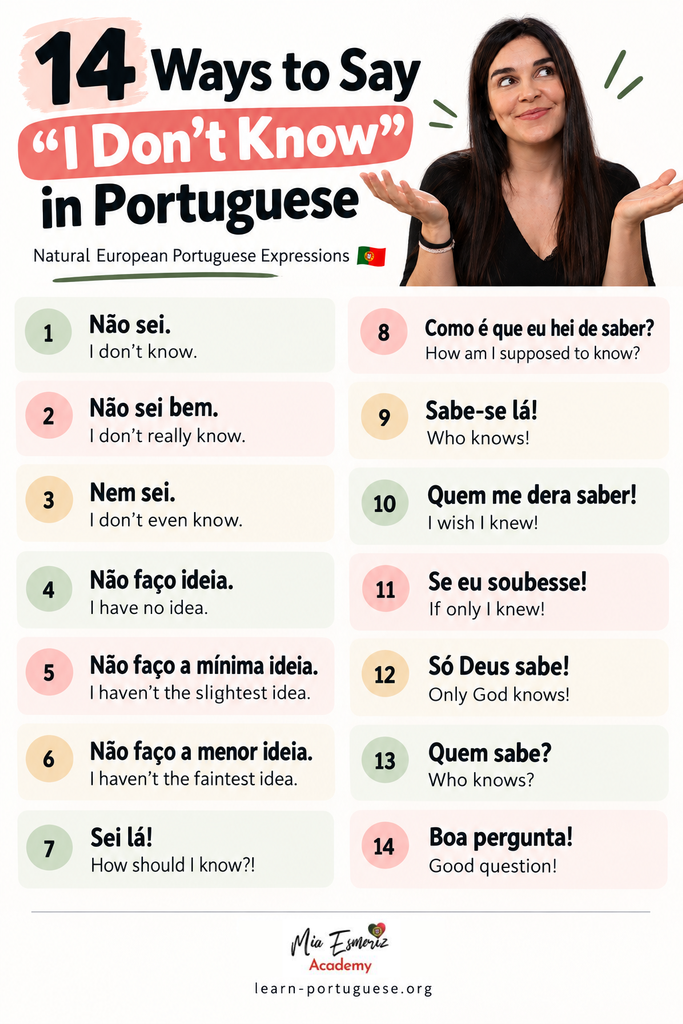
Here’s a handy infographic with all 14 expressions and their English translations. Feel free to save it for later!
Watch the Video: 6 Ways to Say “I Don’t Know” in European Portuguese
Want to hear how these expressions are pronounced by a native European Portuguese speaker?
Watch my YouTube lesson, where I explain six of the expressions covered in this article and help you understand how to use them naturally.
Frequently Asked Questions About “I Don’t Know” in Portuguese
What does “não sei” mean in Portuguese?
Não sei means “I don’t know”. It comes from the verb saber, which means “to know”. It’s the most common and versatile way to express that you don’t know something in Portuguese.
Can I say “eu não sei” in Portuguese?
Yes! Both eu não sei and não sei are correct. In European Portuguese, we often leave out the subject pronoun eu because the verb already tells us who’s speaking. You can include eu when you want to emphasize that you’re talking about yourself.
What does “sei lá” mean in Portuguese?
Sei lá is an informal expression that can mean “I have no idea”, “who knows?” or “how should I know?”, depending on your tone and the situation. It’s commonly used in casual conversations in Portugal.
How do you say “I have no idea” in Portuguese?
A very natural way to say “I have no idea” in European Portuguese is não faço ideia. If you want to make it even stronger, you can say não faço a mínima ideia, meaning “I haven’t the slightest idea”, or não faço a menor ideia, meaning “I haven’t the faintest idea”.
What’s the difference between “sei lá” and “sabe-se lá”?
Sei lá is an informal way of saying “I have no idea” or “How should I know?” It can sound dismissive depending on your tone. Sabe-se lá is closer to “Who knows?” and is often used when something is unknown or difficult to predict.
Practise Your Portuguese!
Now it’s your turn!
Which of these 14 expressions did you already know, and which one was completely new to you?
Let me know in the comments below. I’d love to hear from you!
If you’d like to learn more useful expressions for everyday conversations, have a look at my 50 Common Portuguese Phrases.
And if you’d like to continue improving your Portuguese vocabulary, pronunciation, and grammar, you can start with my free course “Kickstart Your Portuguese – The Basics”.
Start Learning European Portuguese for Free
Até à próxima!
Beijinhos, Mia.