
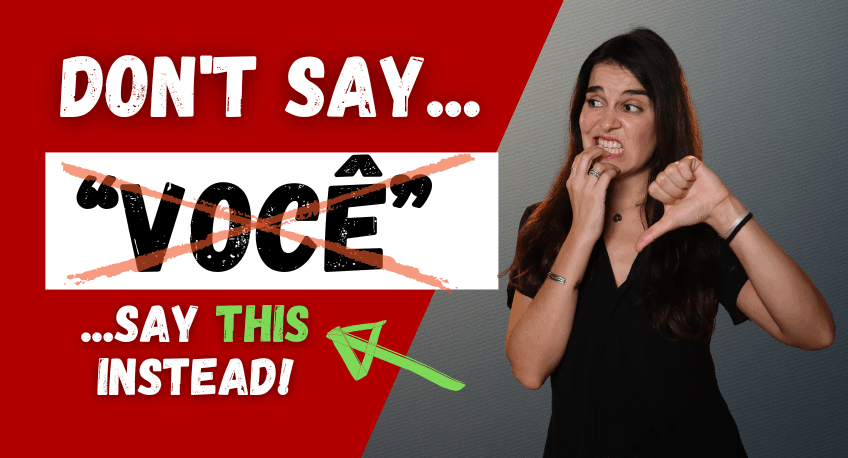
Let’s say you’re in Portugal and you want to talk to someone. You start your sentence confidently and then… wait! Should you use “tu” or “você”? Don’t worry! Today I’m going to clear up the mystery of when to use tu vs você in European Portuguese. Because, trust me, getting this wrong can lead to some awkward situations!
1. The Main Difference Between “Tu” vs “Você” in European Portuguese
Let’s start with grammar.
If you use “tu”, or if you want to address the person this way, you’ll need to use the second-person verb conjugation.
For example:
🇵🇹 Tu fazes? → (Do you do [it]?)
🇵🇹 Tu comes? → (Do you eat?)
If you use “você”, on the other hand, either explicitly or implicitly, you’ll need to use the third-person singular form of the verb:
🇵🇹 Você tem? → (Do you have?)
🇵🇹 Você quer? → (Do you want?)
Note: If you don’t know how to conjugate verbs in Portuguese, you can check out the following article: European Portuguese Verbs and Conjugations
2. “Tu” vs “Você” in European Portuguese – The General Rule
Simply put, “tu” is informal and “você” is formal.
But in Portugal, it’s not that simple!
The general rule is:
✅ Use “tu” when speaking with friends, family, and people your own age.
✅ Use “você” (or the third-person conjugation) when speaking with strangers, older people, or in more formal or professional situations.
For example:
- I’m asking my friend: Tu vais ao cinema hoje? (Do you go to the cinema today?)
- If I’m speaking with someone I don’t know very well or who is older than me: O senhor vai ao evento hoje? (Do you go to the event today?)
Did you notice that in the second example, I used “o senhor” instead of “você”?
That’s because in Portugal, the topic is a little more complex than it seems.
3. The Problem with “Você” in Portugal
Here’s where it gets interesting.
In Portugal, “você” is technically more formal, but depending on how you use it, it can actually sound a bit rude!
In general, it’s better accepted if you use “o senhor” or “a senhora” instead of “você”, especially when you want to sound polite or respectful.
For example:
✅ O senhor deseja mais pão? → (“Would you like more bread?”)
❌ Você quer mais pão? → (“Do you want more bread?”)
That second one sounds a bit too direct!
Of course, this is just a generalization — and it’s not always the case — but this is how the word is often perceived in Portugal today.
Psst… did you know you can also watch this post in video format on my YouTube channel? 🎥
You’ll find the video just below, and if you subscribe to my YouTube channel you’ll be notified whenever I post a new video about European Portuguese! 🇵🇹✨
4. The Social Nuance Behind “Você”
Interestingly, the use of “você” has sometimes been associated with social class or education.
Some people feel that those from higher social classes or with more formal education don’t usually use “você”, while people from lower classes might use it more frequently.
Others say it depends entirely on region and family background — so it’s not a fixed rule, just something you might notice when you live in Portugal for a while.
Either way, it’s useful to be aware of this subtle nuance when speaking Portuguese.
5. How to Avoid Awkward Situations
Here’s a simple rule to help you:
👉 If you’re unsure, listen first!
Pay attention to what the other person uses, and mirror it.
If you want to sound polite, use “o senhor” or “a senhora” instead of “você”.
And here’s a pro tip:
If you’re not sure what to use, you can hide the subject pronoun and just use the verb!
Instead of saying:
- Você come? or O senhor quer vir?
You can simply say:
👉 Come? or Quer vir?
This way, you avoid sounding too formal, but still remain polite.
6. What If Someone Invites You to Use “Tu”?
If the other person prefers that you use “tu”, they’ll often tell you:
🇵🇹 Podes-me tratar por “tu”. → You can use “tu”.
And of course, you can always ask politely:
🇵🇹 Posso tratar-te por “tu”? → Can I use “tu”? (informal version)
🇵🇹 Posso tratá-lo por “tu”? → Can I use “tu”? (formal version)
You can use the formal version, just to be on the safe side!
7. Quick Recap – Tu vs Você in European Portuguese
Here’s a quick recap of what we’ve learned:
😎 “Tu” – informal
🎩 “Você” – technically formal, but can sound rude or outdated in Portugal
✅ “O senhor” / “A senhora” – polite and respectful
And if you’re not sure? Just drop the subject and use the formal conjugation!
That way, you’ll probably not offend anyone.
Have you ever felt confused about when to use “tu” or “você”? Or do you have a funny story about using the wrong one?
Tell me in the comments — I’d love to read them!
And if you want to learn more about formalities and Portuguese expressions, keep following me for more tips on how to speak natural, European Portuguese. You can also check out my free Portuguese course for beginners here:
Kickstart Your Portuguese – The Basics
I hope you found this post useful! 💛
Beijinhos, Mia.